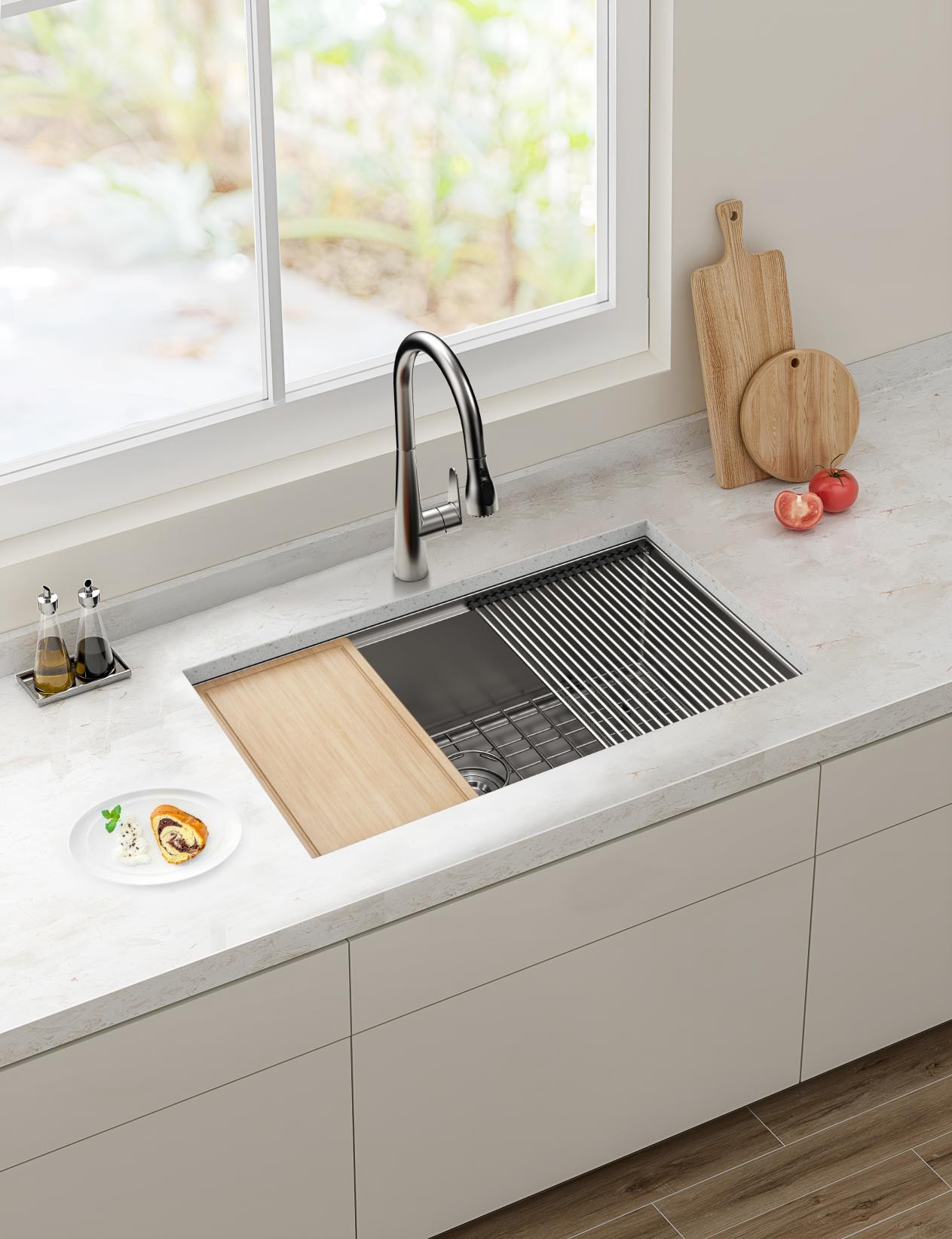
To help you make a more suitable decision when choosing a sink, Zhongshan XIMENNA Kitchen & Bath Sanitary Ware Co., Ltd. will provide you with a detailed analysis of the differences between handcrafted sinks and stretched sinks.
I. Process Differences
1. Handcrafted Sinks: Our handcrafted sinks are meticulously created by skilled artisans. First, high-quality stainless steel sheets are precisely cut using laser cutting, then shaped into the desired form through CNC bending, and finally, the four corners are welded using CNC automatic welding technology. The entire process is like elaborately carving a work of art, fully demonstrating the craftsmen's superb skills. This process maximizes the retention of the original properties of the stainless steel material, making the sink thick and bright.
2. Stretched Sinks: Stretched sinks are formed by stamping and stretching a whole piece of steel plate in one go using large hydraulic presses and specific molds. The principle is similar to blowing a balloon, where pressure makes the steel plate fit the shape of the mold. This process is relatively efficient and can quickly produce a large number of sinks.
II. Material and Thickness
1. Handcrafted Sinks: In terms of materials, we insist on using high-quality 304 stainless steel with a nickel content of 8%, which is environmentally friendly and lead-free. Its thickness is generally 1.2-1.5mm, uniformly thick. Like a solid shield, it can effectively resist various impacts and scratches in daily use, ensuring the durability of the sink.
2. Stretched Sinks: Some stretched sinks use lower-grade stainless steel sheets such as 201, which are slightly inferior in quality and safety. Their thickness usually does not exceed 0.8mm, and due to the stretching process, the bottom and corners of the sink will be appropriately thinned, which has certain limitations in terms of durability.
III. Appearance Design
1. Handcrafted Sinks: With strong and powerful lines, most adopt the design concept of small R-angle or right-angle square-circle. This design not only increases the washing space but also makes the sink look more concise and elegant, full of modern sense, and can perfectly match various kitchen decoration styles. The surface is finely brushed, with a full texture, showing luxury and high grade.
2. Stretched Sinks: Due to the limitations of machinery and equipment, it is impossible to make corners close to right angles, mostly rounded and smooth corners. The appearance is relatively ordinary, lacking the unique line beauty of handcrafted sinks. The surface is mostly treated with pearl sand pickling, which has a simple process, low cost, and a slightly weaker overall sense of grade.
IV. Performance Comparison
1. Handcrafted Sinks: The depth can usually reach 200mm, and the large-capacity design can meet various washing needs, while effectively preventing water splashing. The bottom adopts an oversized drainage system, an anti-overflow device, and an X-shaped water guide line, which can quickly drain every drop of water and avoid water accumulation.
2. Stretched Sinks: The tank body is relatively thin, and during long-term use, it is prone to problems such as perforation and water leakage due to wear. Due to the larger R-angle design, the sink space is not as efficient as that of handcrafted sinks in terms of space utilization.
Zhongshan XIMENNA Kitchen & Bath Sanitary Ware Co., Ltd. hopes that through these comparisons, you can clearly understand the differences between handcrafted sinks and stretched sinks, so as to choose the most suitable sink for your kitchen.